The women who sent a man to space
Portfolio | Writing | Data Teams | History
April 2024
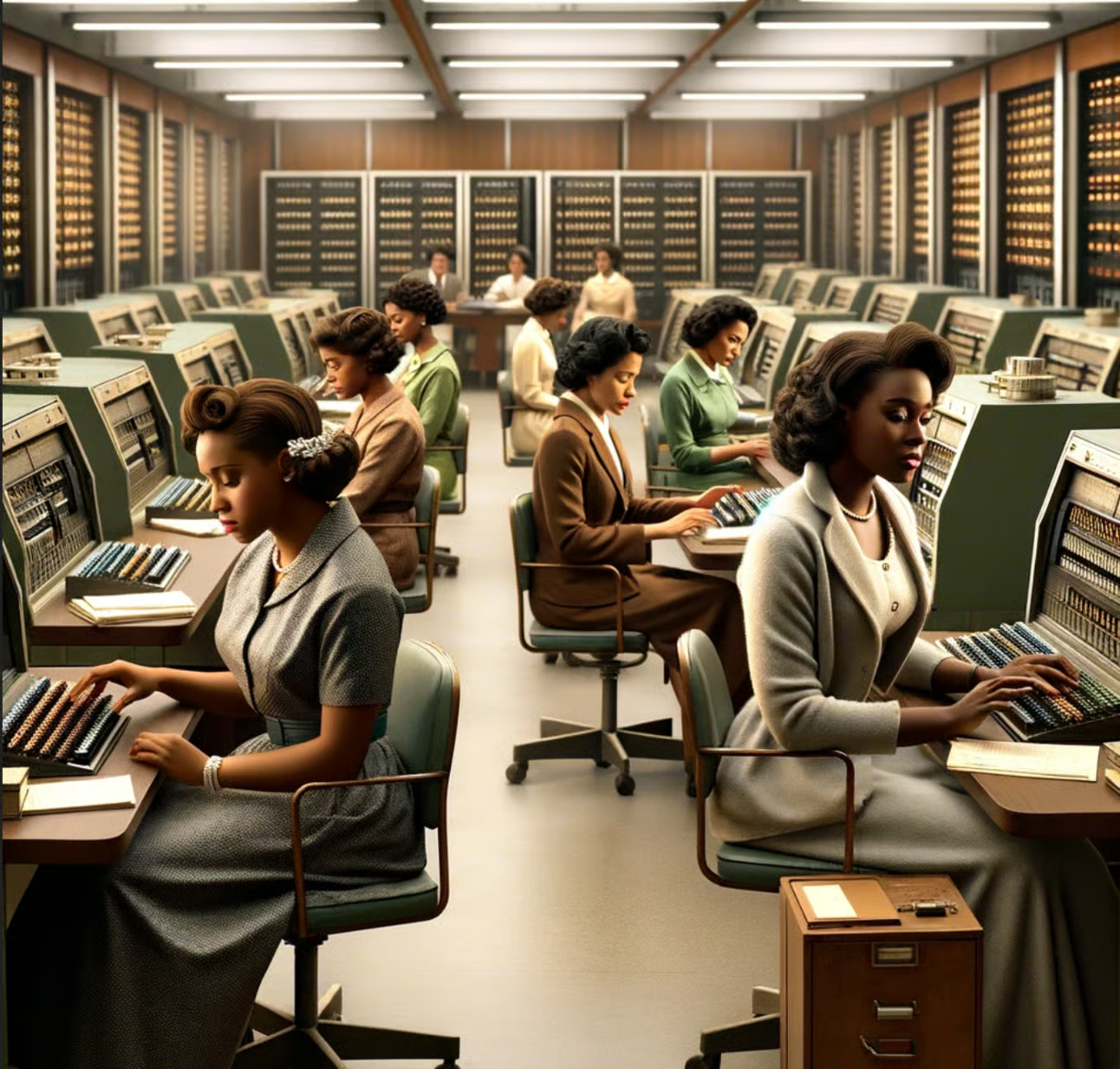
Breaking Barriers
The sonic wave boomed as Chuck Yeager flew his Bell X1 jet past the speed of sound in the fall of 1947. It was a feat measured by an enterprising group of computer programmers in Langley, Virginia. The "West Computing Pool" of NACA (later NASA) had broken barriers of its own. The team of analysts was made up almost entirely of Black women. Mathematicians like Katherine Goble Johnson, Dorothy Vaughan, and engineers like Mary Jackson — showcased in Margot Lee Shetterly's book and the subsequent film Hidden Figures — proved that resilience, ingenuity, and tight bonds can produce a history-making data team.
Within Langley's segregated campus, the West Computers faced more than just the challenges of math. They confronted the vitriolic segregation of Jim Crow and the gender bias of mid-twentieth century America. They overcame educational barriers — Mary Jackson became the first student to desegregate local engineering classes. They fought for jobs they were overqualified for during WWII, facing the return of men post-war. Moving from the warehouse to the West building at NACA and eventually to Houston for NASA's new headquarters, they faced a society where equality seemed more distant than the moon.
Charting the Course
Despite being officially classed as "sub-professionals," they were integral to NACA, performing critical computational work that supported flight research and engineering projects. They operated the fastest computer at the time — the IBM 7090 — "calculating data sheets, reading film and plotting numbers." That is, whenever they didn't use a slide rule, analog calculator, or chalkboard to run calculations and plot coordinates for the space missions.
"I was able to stand on the shoulders of those women who came before me, and women who came after me were able to stand on mine." — Christine Darden, NASA
The loose-knit team of West Computers, amounting to more than 20 Black women, spread out across multiple departments. "Working closely in a team was key to the entire operation, and Dorothy Vaughan had both a license and an obligation to see to it that her Computers were set up on the best career paths possible," according to Shetterly. So she taught herself FORTRAN, the early punch-card based computer programming system, and then imparted her knowledge on the other programmers. Together they charted the courses for Alan Shepard's 1961 orbital flight and John Glenn's space mission, some even gaining authorship on published research. These "hidden figures" played a pivotal role in the space race against the USSR, showcasing the critical impact of their work on a global scale.
Shared Struggle
Integral to their coordination at Langley were the tight bonds that come from a shared struggle. The West Computers lived in the same neighborhoods of Hampton Roads. They attended the same AME church. And at Langley in the 1950s, they sat at segregated lunch tables together, famously throwing away the "colored only" sign as often as they could. They formed a fluid and dynamic structure, deftly navigating the minefields of being a Black woman in mid-twentieth century America.
Inspiring generations, they helped break color and gender barriers, paving the way for diversity in the sciences. Christine Darden became one of NASA's preeminent experts on supersonic flight and sonic booms. The West Computers realized the dream envisioned by Martin Luther King even before his famous speech at the March on Washington. They are credited as inspirations for Star Trek's Uhura. And of course, their research laid the foundation for significant moments in history, such as the moon landing. The West Computers' story exemplifies the power of determination and teamwork in overcoming challenges, embodying the belief that every dream begins with a first step.
Metaphor to Nature
At dusk, a murder of crows gathers around a park water fountain. One, wiser or perhaps just braver, nudges the button with its beak, unleashing a stream of water. They drink in turns, a quiet cawing among them, before the shadows call them back to their secret roost.