How the industrial lab changed the way we work together
Portfolio | Writing | Data Teams | Research
January 2024
Countless articles and books exist about Bell Labs' contributions to technologies commonplace today. From the transistor to satellites to the personal computer, the list of inventions the Labs developed between the 1930s and 80s dwarfs that of any academic or industrial lab in history. Less research exists, however, on its contributions to data analysis and how research teams operate — with an attention to interdisciplinarity, trust, and openness.
By all accounts, Bell Labs advanced how to perform analysis. Researchers like Claude Shannon developed information theory, laying the groundwork for all modern digital communication. As Vicki Boykis has described, "the most efficient way to inspect information was to not look at the actual data, but to analyze the statistical properties of that message" — not unlike how we analyze the metadata of today's digital products. Later, Ken Thompson and Dennis Richie invented a computer time-sharing method which evolved into the UNIX operating system, and as a byproduct, the Labs developed the theoretical framework for cloud computing. Yann LeCun, who would later become Chief AI Scientist at Meta, developed machine learning and image recognition methods in the 1980s at Bell Labs too. Through its decades of research, these contributions became instrumental to the discipline of data analysis.
Interdisciplinarity
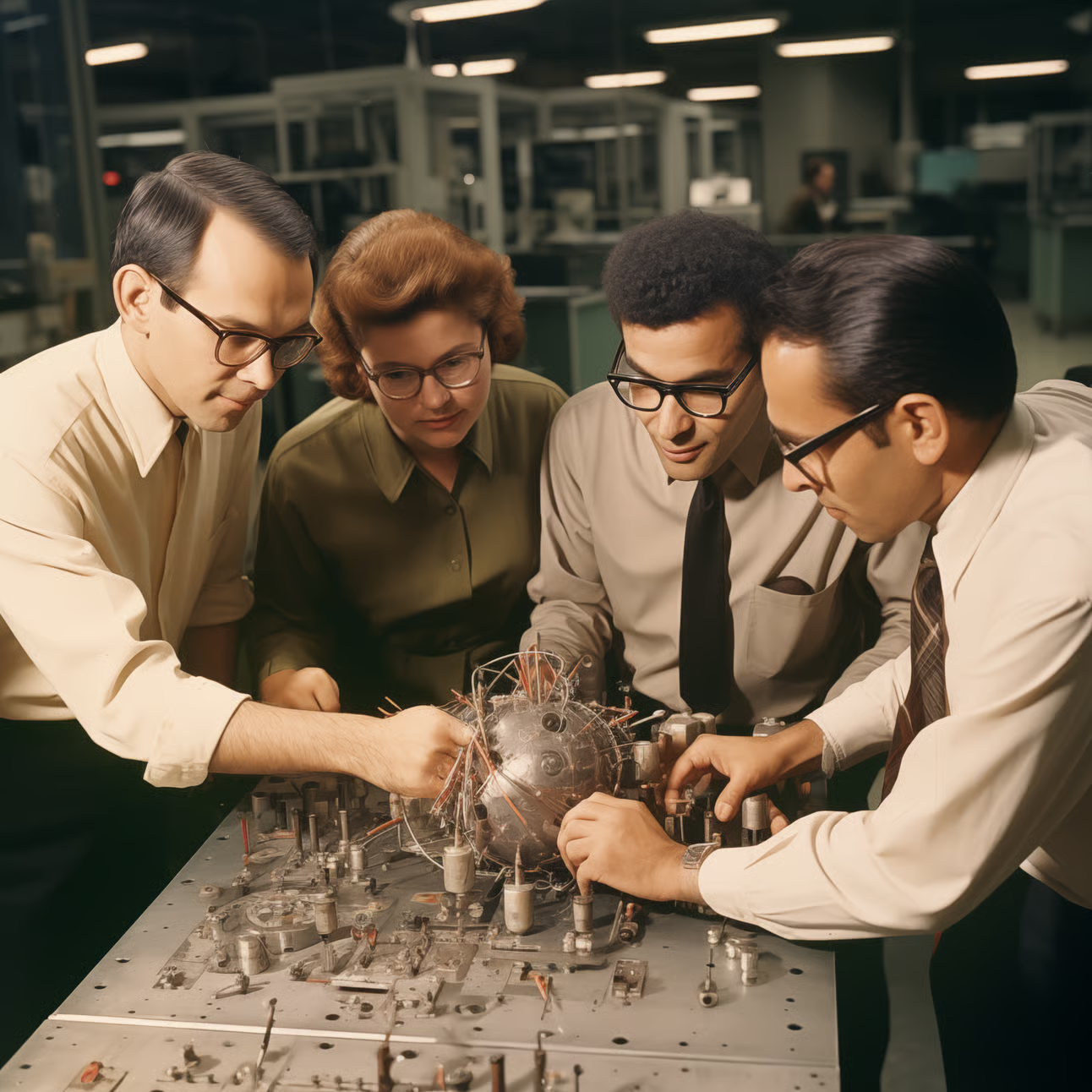
Beyond its technological inventions and contributions to pure science, Bell Labs invented modern research. The Solid State team, which invented the transistor in the 1950s, were among the first industrial laboratories to adopt the concept of interdisciplinary research. Mervin Kelly, one of the Labs' managers at the time, "believed the most valuable ideas arose when the large group of physicists bumped against other departments and disciplines too." As one academic later noted, "it's the interaction between fundamental science and applied science and the interface between many disciplines that creates new ideas."
Trust
The Labs also fostered an "atmosphere of autonomy with a web of human connections . . . people who trusted each other and depended on the expertise of others." As one 1970s researcher described it, there were "really good people doing really interesting things, and nobody telling you what to do." Not to mention that the telephone monopoly AT&T enjoyed offered the Labs wide latitude to embark on multi-year projects which often failed. Historian Michael Riordan called it "a built-in R&D tax on telephone service."
Openness
Openness was not always the Labs' focus during its government work in WWII and the Cold War, but it later became known for exactly that. The UNIX project called its approach "ego-less programming." The method of sharing code across team members can be seen as a precursor to version control methods used in Git today. In a later admission, one of the lead developers joked about leaving a vulnerability in one compiler, noting that "you can't trust code that you did not totally create yourself." Even today, Yann LeCun has continued advocating for Meta to open-source generative AI models, which he first began working on at Bell Labs. As he recently said, the models are "going to become a basic infrastructure that everybody is going to use — it has to be open."
In the end, the Labs' source of strength became its undoing. AT&T's monopoly on the telephone market, which allowed the Labs wide latitude to subsidize years-long research initiatives, drew the ire of federal regulators. The monopoly broke up, and Bell Labs never looked the same again.
Bell Labs' technological inventions and advancements in pure science revolutionized how researchers work. Perhaps more notable, though, were its innovations to how researchers work together — by building cross-functional teams with a high degree of latitude, trust, and a bend toward openness.